Thailand’s Constitution Gives the People Power but Not the Right to Question It
How Sections 3 and 112 Shield Power and Weigh on Progressive Parties
Prem Singh Gill’s article examines how Thailand’s 2017 Constitution creates a fundamental contradiction by granting sovereign power to the people under Section 3, while simultaneously shielding royal political initiatives from public scrutiny through Section 112. By expanding royal prerogatives and criminalizing criticism of the monarch, the legal framework restricts citizens' ability to hold power accountable, placing the heaviest legal and political burdens on progressive reformist parties like the People’s Party.
October 26, 2026
Thailand has rewritten its constitution roughly twenty times since 1932. The 2017 text is the twentieth. Few countries have drafted so often, and few have ended up with so little settled agreement on what the words mean.
Many sections of the current charter remain unclear. Their meaning is filled in later, case by case, by courts, independent agencies, and the political actors who benefit from the ambiguity. That uncertainty is not neutral. It favours those who already hold power, and it burdens those who try to change it.
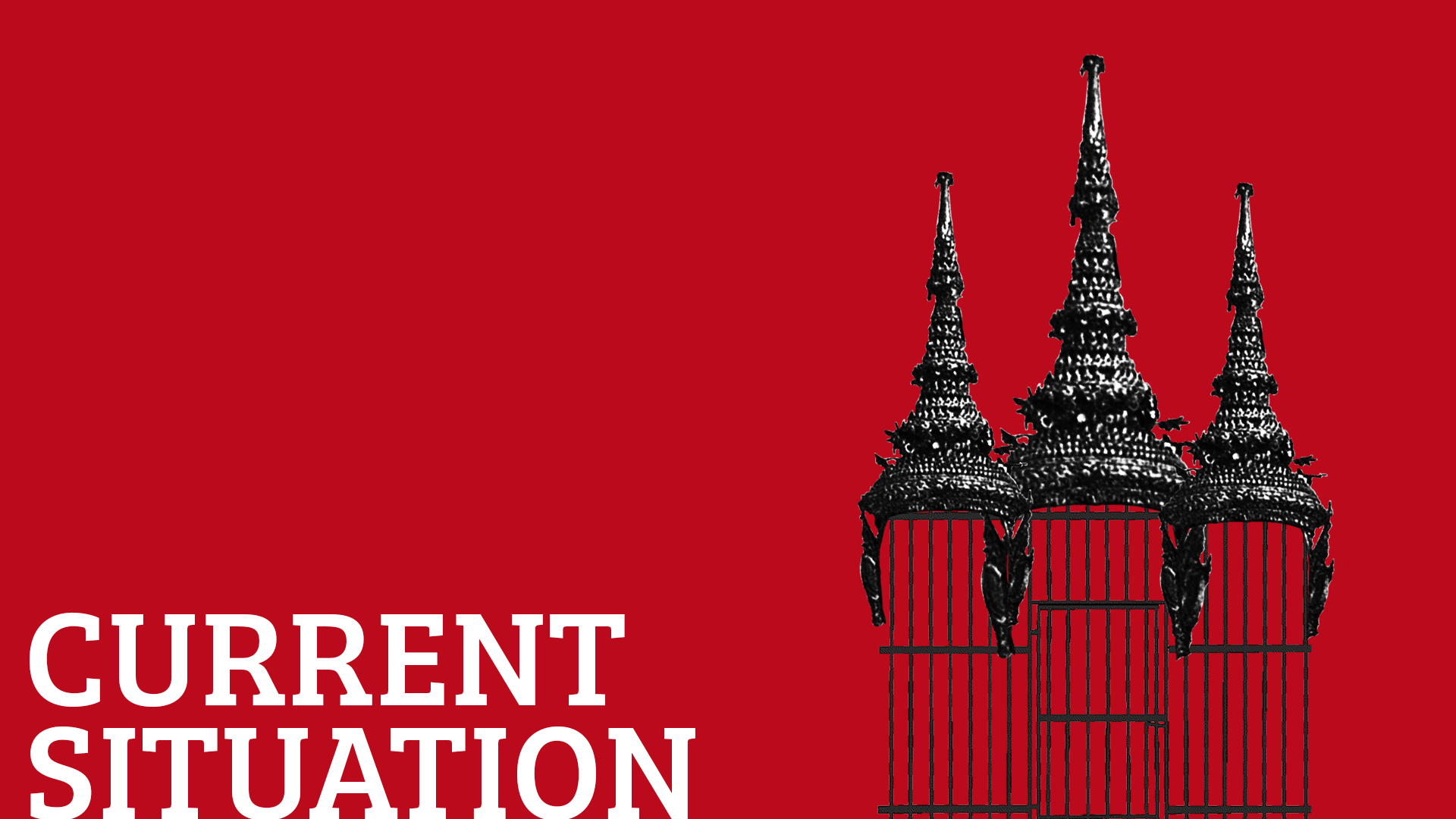
Then comes Section 3, with a clean and confident sentence. Sovereign power belongs to the Thai people, and the King exercises it in accordance with the Constitution. The people hold the title. The monarch acts as the formal trustee of that title. Yet the sentence never stands alone. Beside it stands Section 112 of the Criminal Code, which makes certain speech about the King a criminal offence carrying heavy penalties.
Read together, the two texts shrink the promise of popular ownership. The people are told they possess the power. They are also cautioned that examining how the King uses it may expose them to prosecution. What presents itself as a constitutional gift becomes, in lived practice, a carefully guarded enclosure. This article asks who is locked out, and who pays the price.
Who Dissolves Parliament?
Section 3 has always carried a dual character. It affirms that ultimate authority rests with citizens. It also places the King at the formal centre of that authority.
In earlier constitutions, convention and consistent practice managed this tension. The monarch acted on ministerial advice. Dissolving the House of Representatives required a royal decree and a countersignature. Political responsibility stayed with the government. The King signed; he did not originate the decision.
Worachet Pakeerut addresses this question with unusual clarity. He firmly rejects the argument that Section 3 gives the King an independent power to initiate dissolution Such a reading, he argues, would pull the monarch directly into ordinary political choice. Once the King originates a dissolution rather than formally authorising it, the act changes character. It ceases to be a minister’s responsibility and becomes a royal decision.
At that point, criticism turns hazardous. If the decision is later questioned, the conversation risks entering the territory of Section 112. A law designed to protect the monarchy’s dignity can then close down debate about the wisdom or timing of a political act performed in the King’s name.

The King Signs, the Executive Decides
Thailand’s constitutional record points consistently the other way. The first dissolution under the permanent 1932 Constitution came in 1938, under Phraya Phahol Pholphayuhasena. It was carried out by royal decree after a Cabinet process. Later practice evolved. Sometimes a Cabinet resolution preceded the submission. More often the Prime Minister alone submitted the request.
Throughout the long reign of King Rama IX, every request for dissolution was granted. The King never refused. Equally, he never initiated a dissolution on his own motion. Initiation rested with the political executive, while the formal act remained royal.
In the era of General Prem Tinsulanonda, dissolution was sometimes a strategic tool to avoid an impending no-confidence debate. The calculation belonged to the Prime Minister. The same pattern held in later governments: the government bore responsibility, and the King performed the formal role. Because the King was never the originator, space for political argument about the decision stayed relatively open.
Royal Powers Beyond the Countersignature
The 2017 Constitution altered the surrounding landscape. Compared with earlier texts, it expanded the range of powers the King may exercise in personal and certain institutional matters without the traditional countersignature.
The change was presented as a restoration of royal prerogative. In practical effect, it enlarged the zone of royal action that sits outside the ordinary chain of political responsibility. Worachet maintains that dissolution still requires a countersigning minister. Even so, the broader climate has shifted. The text now gives stronger support to those who treat Section 3 as a residual sovereign authority, to be activated when ordinary politics appears blocked.
Popular ownership remains intact on paper. But the institutional space in which it can be asserted against royal initiative is narrower than in any previous modern Thai constitution.
When Scrutiny Becomes a Crime
Section 112 does not merely protect personal dignity. Combined with an expansive reading of Section 3, it becomes a structural limit on constitutional argument itself.
In democratic theory, power is legitimate because it stays open to continuous examination. Citizens must be able to ask whether a decision was necessary, timely, or wise. When a decision is attributed to the King, and criticism of the King is broadly criminalised, the ordinary instruments of accountability are partly disabled.
Worachet returns repeatedly to political responsibility. It must rest with the person who countersigns the royal command. The King should never become the visible author of a contested political choice. If he does, the protective logic of Section 112 begins to operate as a barrier around the choice itself. The public is left with two options: accept the decision in silence, or risk criminal consequences by examining it too closely. The Constitution still declares that the people own the power. The criminal law ensures that the ownership is exercised under constrained speech.

Progressives Pay the Price
The burden does not fall evenly. It falls hardest on parties that promise to change the arrangement, above all the progressive camp now represented by the People’s Party (Phak Prachachon). The pattern is already on record. Future Forward was dissolved by the Constitutional Court in 2020. Its successor, Move Forward, won the most seats in the 2023 election but was blocked from forming a government.
In January 2024 the Court ruled that Move Forward’s campaign to amend Section 112 amounted to an attempt to undermine the constitutional monarchy. In August 2024 it dissolved the party and banned eleven of its executives from politics for ten years. The People’s Party emerged from that dissolution, carrying the same platform and the same caution. Its leaders now campaign knowing that the one reform at the heart of this article may itself be treated as a threat to the state.
Here the lack of constitutional clarity does its quiet work. When the limits of permitted debate are vague, the safest course is silence. Parties of the status quo rarely need to test those limits. Reformist parties must test them just to do their job. The result is a lopsided contest. Conservative actors operate inside the enclosure with confidence. Progressive actors approach the locked door knowing that each knock may be read as an offence.
An Unprecedented Arrangement
By expanding certain royal powers while leaving the severity of Section 112 untouched, the 2017 Constitution produced an arrangement unprecedented in the modern Thai constitutional order.
Earlier constitutions kept the monarchy more clearly inside the framework of ministerial responsibility. The 2017 text moved that boundary, at a moment when Thai politics was already marked by repeated interventions and contested readings of constitutional authority. The result is a constitution that speaks the language of popular sovereignty while strengthening the barriers that limit how that sovereignty may be discussed when the King is involved.
The consequences are visible in the hesitation around serious public discussion of royal political initiative. Scholars, journalists, and politicians learn the boundaries quickly. Certain questions are framed with extreme care, or left unasked. The claim that sovereignty belongs to the people is repeated in official language. The conditions under which it can be tested against the highest exercise of power grow more restricted.
Ownership Without Access
Picture a large house whose legal deed is written in the name of every citizen. The rooms are declared to belong to all. Yet one chamber stands locked, and the key is held by a figure who may not be questioned too closely about the use of the room. The deed is unchanged. The language of ownership continues to be spoken in public. But the lived experience of ownership is incomplete. Those who inhabit the house learn which doors they may open freely and which they approach only with caution.
Thailand’s 2017 Constitution has built such a chamber. Section 3 places the formal title of sovereignty in the hands of the people. Section 112, together with the expanded royal powers of the same constitution, places a barrier around the most sensitive exercise of that sovereignty.
Worachet Pakeerut’s warning remains the clearest recent statement of the risk. Once the King is permitted to initiate political acts under Section 3, space for open argument contracts. Criticism becomes dangerous. Political responsibility is displaced from the executive onto a figure protected by criminal law. The deeper difficulty is not merely technical or legal. It concerns the nature of ownership itself. Power that cannot be examined without risk is power only partially possessed.
A constitution that declares the people sovereign while limiting their capacity to scrutinise the highest uses of that sovereignty has not resolved the ancient tension between authority and accountability. It has relocated the tension into the structure of the text and the surrounding criminal law.
The language of popular ownership continues. The practice of restricted speech continues beside it. Between the two lies the quiet but solid barrier that the 2017 Constitution has made more durable than any earlier Thai constitution attempted.
Prem Singh Gill
Prem Singh Gill is a Fellow of the Royal Asiatic Society of Great Britain and Ireland. He is also a scholar at public universities in Thailand.