Statement: Royal Thai Police Ban Routledge Handbook of Contemporary Thailand, Second Edition
The Royal Thai Police has banned Routledge Handbook of Contemporary Thailand, Second Edition, edited by Pavin Chachavalpongpun and published by Routledge in August 2026. The order cites national security and public morality, and warns that violations may carry up to three years’ imprisonment and/or a fine of 60,000 baht. Bringing together 45 scholars across 37 chapters, the book examines Thailand’s history, politics, economy, society, and international relations. Pavin expresses serious concern that an academic publication is being treated as a threat and calls on Thai authorities to reconsider the ban and respect academic freedom, freedom of expression, and the public’s right to access knowledge.
November 7, 2026
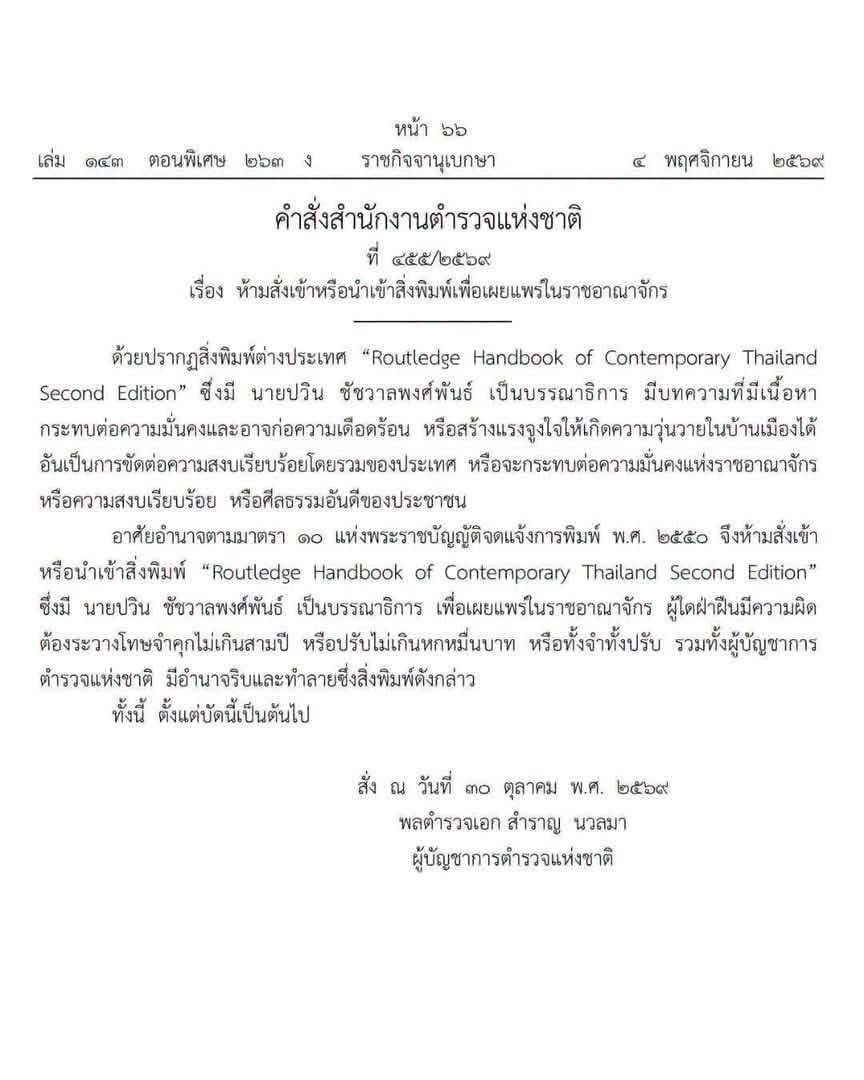
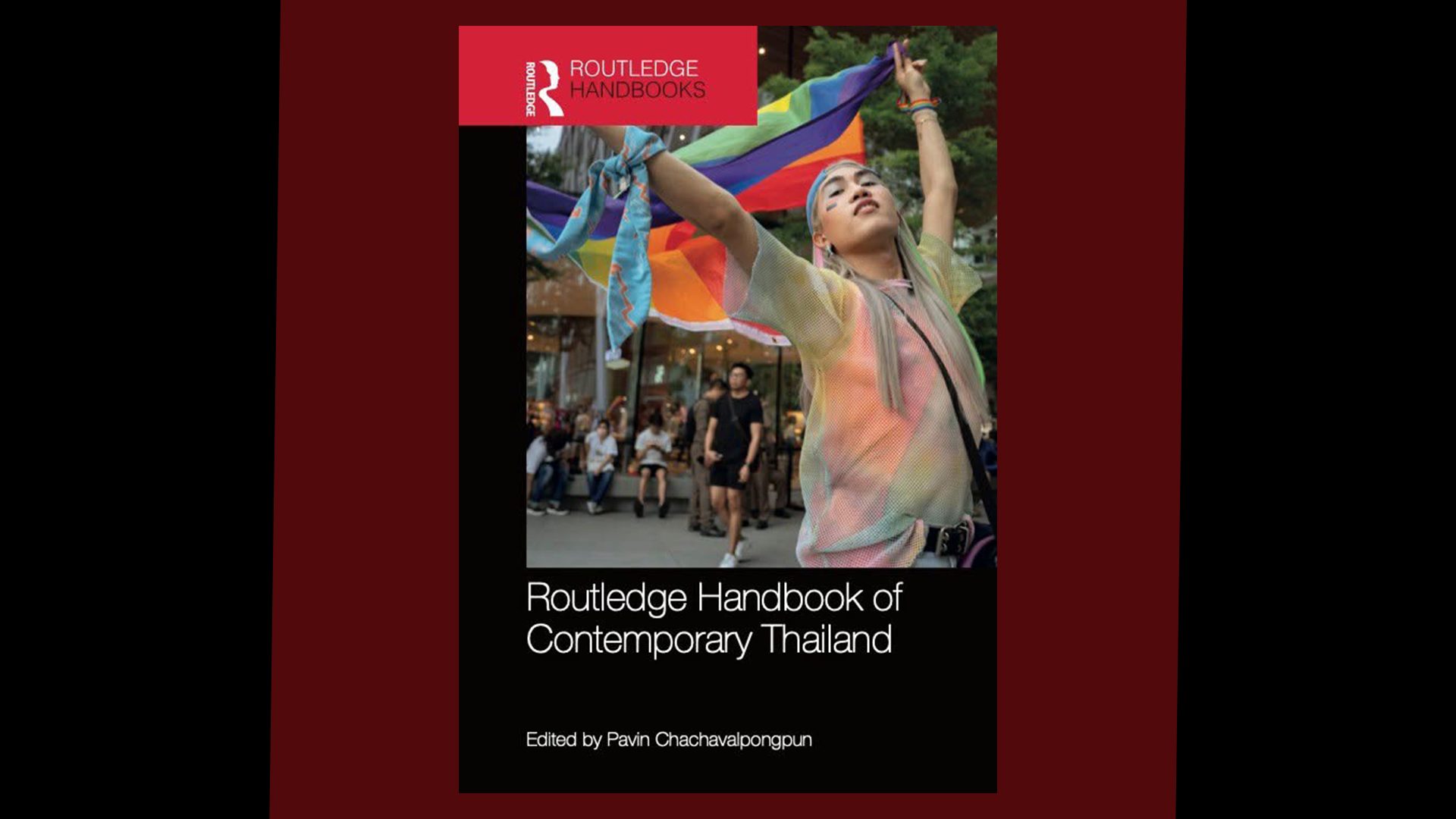
Pavin Chachavalpongpun’s edited volume, Routledge Handbook of Contemporary Thailand, Second Edition, published by Routledge in August 2026, has been banned in Thailand by the Royal Thai Police.
According to the official police order, dated 30 October 2026 (Order No. 555/2569), the importation and publication of this book within Thailand are prohibited. The order, issued under Section 10 of Thailand’s Printing Act B.E. 2550 (2007), claims that the book contains material that could affect national security, provoke public unrest, undermine public order, or offend public morality. It further warns that anyone who violates the order may face imprisonment of up to three years, a fine of up to 60,000 baht, or both. The order also authorises the police to seize and destroy copies of the book.
The police order specifically identifies Pavin as the editor of the volume. It is deeply concerning that an academic publication examining contemporary Thailand through the work of leading scholars from different disciplines has been treated as a threat to national security. The book is a scholarly contribution intended to encourage informed discussion, critical inquiry, and a deeper understanding of Thailand—not to incite unrest or threaten public order.
The second edition comes seven years after the publication of the first edition and offers an updated, comprehensive examination of contemporary Thailand. Pavin served as the editor of this substantial volume, bringing together 37 chapters across 474 pages, written by 45 leading scholars. The contributors examine Thailand's historical development, political and economic structures, social transformations, and international relations. The volume addresses a wide range of subjects, including democracy, the monarchy, the military, authoritarianism, human rights, Buddhism, gender and sexuality, social movements, environmental politics, foreign policy, and transnational repression.
The book is organised into four parts:
- Part I: The History – examining Thailand's historical development, historiography, and post-war economic transformation.
- Part II: The Political and Economic Landscape – exploring democracy, coups, military power, the monarchy, authoritarianism, political movements, the judiciary, economic development, and state institutions.
- Part III: Social Development – addressing national identity, Buddhism, education, human rights, gender and sexual diversity, social media, protest movements, environmental politics, and the impact of COVID-19.
- Part IV: International Relations – analysing Thailand's foreign policy, international status, relations with major powers, neighbouring countries, ASEAN, and transnational repression.
The complete table of contents is provided below.
Table of Contents
PART I: THE HISTORY
- Introduction: A Timeless Thailand — Pavin Chachavalpongpun
- Thailand in the Longue Durée — Chris Baker and Pasuk Phongpaichit
- Thai Historiography — Charnvit Kasetsiri
- Economic Development in Post-War Thailand — Peter Warr
PART II: THE POLITICAL AND ECONOMIC LANDSCAPE
- Thailand’s Two-Faced Democracy: From 1932 to the Present — Michael K. Connors
- Thailand’s Royalist Coups d’État: Past and Future — Federico Ferrara
- The Military and Authoritarian Persistence in Thai Politics: The Development of the Hybrid Regime — Surachart Bamrungsuk
- Rethinking Thailand’s Urban–Rural Divide — Napon Jatusripitak
- Thailand’s Authoritarianism in Comparative Perspective: Sophisticated or Retrograde? — Greg Raymond
- Conflict and Contestation in the Royal Thai Police: An Alternative Army — Paul Chambers
- Thailand’s 21st-Century Monarchy — Kevin Hewison
- Lèse-Majesté within Thailand’s Failing Regime of Intimidation — David Streckfuss
- Conservative Activism in Contemporary Thai Politics: From Yellow Shirts to the Whistle Rebels — Aim Sinpeng and Youngjoon Koh
- Thailand’s Red Shirt Movement: Born out of Conflict and Branded with Contestation — Saowanee T. Alexander
- Thailand’s Judiciary: From Judicialisation to Politicisation? — Björn Dressel and Khemthong Tonsakulrungruang
- Local Government and Intergovernmental Relations in Contemporary Thailand: Between Central Control and Local Aspirations — Grichawat Lowatcharin
- Thai State Formation and the Political Economy of the Middle-Income Trap — Apichat Satitniramai
- Thailand and International Trade: A Growth Engine Losing Steam? — Krislert Samphantharak
- Industrialisation, Technological Upgrading, and Innovation in Thailand — Patarapong Intarakumnerd
- Transport and the Thai State — Saksith Chalermpong and Prasongchai Setthasuravich
PART III: SOCIAL DEVELOPMENT
- Thai Identity and Nationalism — Saichol Sattayanurak
- Buddhism, Power, and Resistance in Thailand — Edoardo Siani
- Sangha, State, and Secularism in Thailand: Mind the Age Gap? — Tomas Larsson and Stithorn Thananithichot
- Buddhism, Monarchy, and Thai-Style Democracy — Suraphot Thaweesak
- Violence, Identity, and Peace Efforts in Southern Thailand: The Southern Conflict — Anders Engvall and Magnus Andersson
- Education in Contemporary Thailand — Wannaphong Durongkaveroj
- Enduring Constraints and Struggles for Democracy and Human Rights in Thailand since the 2014 Military Coup d’État — Titipol Phakdeewanich
- Thai Queer and Trans Cultures, Communities, and Politics: Gender and Sexual Diversity — Peter Anthony Jackson
- Thailand and Social Media: A Consolidated Online Society — Wolfram Schaffar
- The Cycles of Protest and the Rise and Decline of Thailand’s Youth Movement: A Preliminary Analysis — Somchai Phatharathananunth
- Thailand’s Environmental Politics — Eli Elinoff and Vanessa Lamb
- COVID-19 and the Impact on Thailand — Piyapong Boossabong and Pobsook Chamchong
PART IV: INTERNATIONAL RELATIONS
- Thailand’s Foreign Policy — Arne Kislenko
- Thailand’s International Quests for Status Symbols: Arms, Aid, and Arena — Peera Charoenvattananukul and Wisarut Larsakul
- Thailand and the Great Powers — Matthew Phillips
- Thailand’s Foreign Policy towards Neighbouring Countries and ASEAN — Paul Busbarat
- Transnational Repression in Contemporary Thailand: Building Capacity to Suppress Dissent beyond Borders — Mark Cogan
Academic Freedom and the Right to Knowledge
The decision to ban this book raises serious questions about academic freedom, freedom of expression, and the circulation of knowledge in Thailand. Academic research should be assessed through scholarly debate, evidence, and intellectual exchange—not suppressed through the invocation of national security or public morality.
A book that brings together 45 scholars to examine the historical, political, economic, social, and international dimensions of Thailand should be an opportunity for public learning and debate. Instead, the police order seeks to prevent the book from entering and circulating within the country. This is particularly troubling because the volume includes contributions from scholars working on a broad range of subjects, many of which are essential to understanding Thailand's contemporary challenges.
The implications extend beyond the editor and individual contributors. A ban of this kind risks restricting access to academic research, discouraging critical scholarship, and sending a chilling message to researchers, publishers, students, and readers. It also raises concerns about the freedom of international academic publishing and the ability of scholars to engage in open discussion about Thailand.
Pavin calls on the Royal Thai Police and the relevant Thai authorities to reconsider this order and respect academic freedom and the fundamental right to access information and knowledge. Scholarly discussion, including critical examination of political institutions and public policy, should not be treated as a threat to national security.
A society confident in its institutions should be able to accommodate critical scholarship and open debate. Banning an academic book does not resolve the questions it raises; it only restricts the public's ability to discuss them.
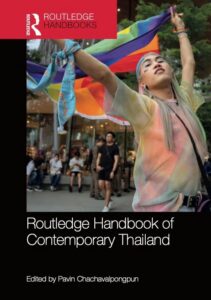 Book Information
Title: Routledge Handbook of Contemporary Thailand, Second Edition
Editor: Pavin Chachavalpongpun
Publisher: Routledge
Publication: August 2026
ISBN: 9781041112860
Length: 37 chapters | 474 pages
Book details: https://www.routledge.com/Routledge-Handbook-of-Contemporary-Thailand/Chachavalpongpun/p/book/9781041112860