Reflections on Weight of Sentences: Solidarity, Memory, and the Cost of Dissent
In this reflective essay, Xun-ling shares his emotional experience visiting the Weight of Sentences exhibition at Queen Mary University of London, which showcases 30 posters created from the words of those impacted by Thailand’s Section 112 lèse-majesté law. Moved by encountering the words of an imprisoned friend and struck by the diverse voices represented across Thai society, he highlights three particularly memorable works—an 18-year prison calendar, a solidarity petition, and an ambiguous piece balancing defiance with despair. Ultimately, he emphasizes how tangible art exhibitions bridge geographical distances, preserve memory, and foster cross-border solidarity among pro-democracy allies in Thailand, Hong Kong, and beyond.
November 20, 2026
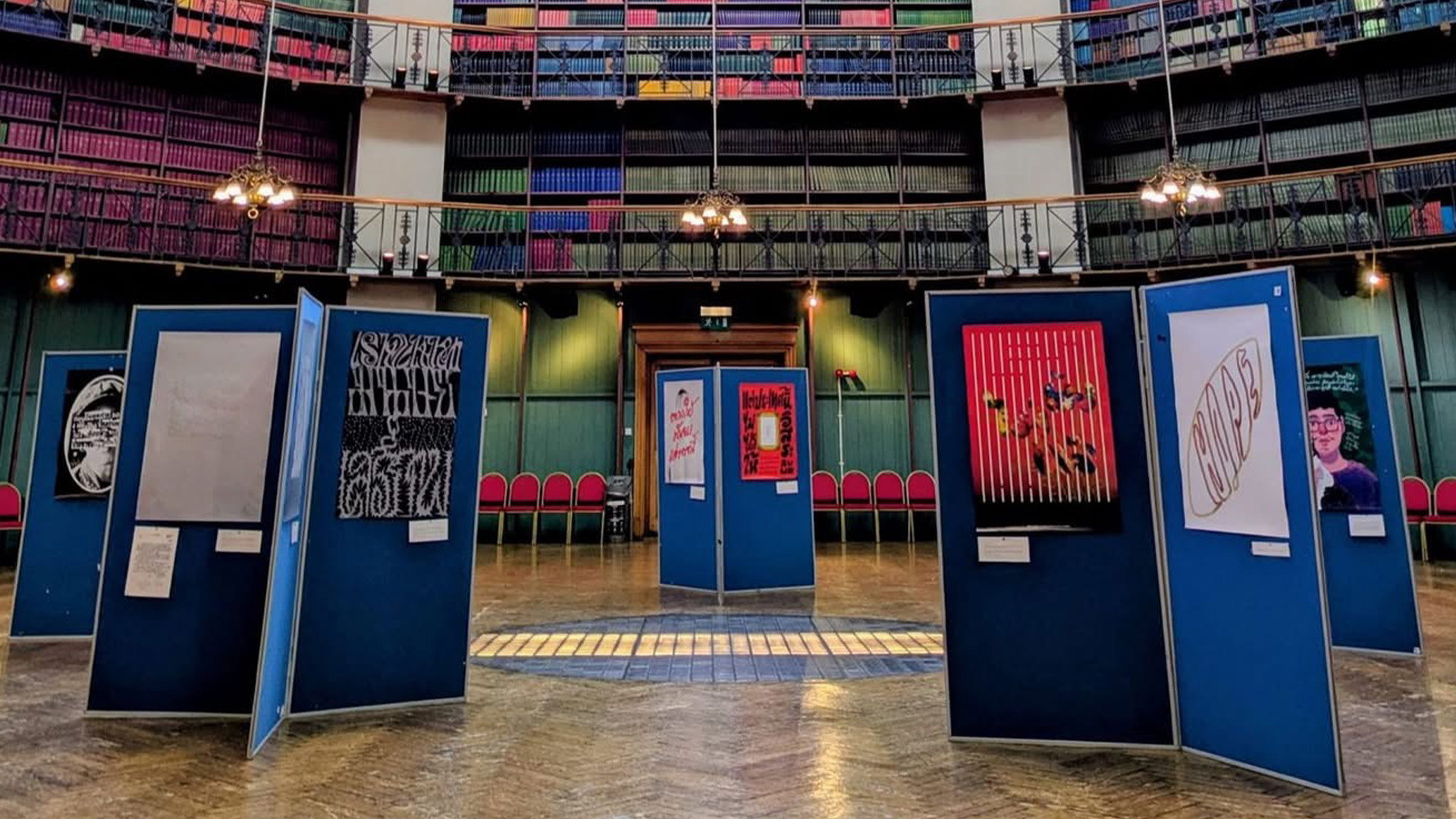
These reflections follow my visit to the exhibition Weight of Sentences at Queen Mary University of London—a showcase of 30 posters rooted in the words of those impacted by Section 112, Thailand’s lèse-majesté, or royal defamation, law. Since the youth-led protests of 2020 and 2021, this law has been one of the primary tools used to silence and suppress activists across Thailand.
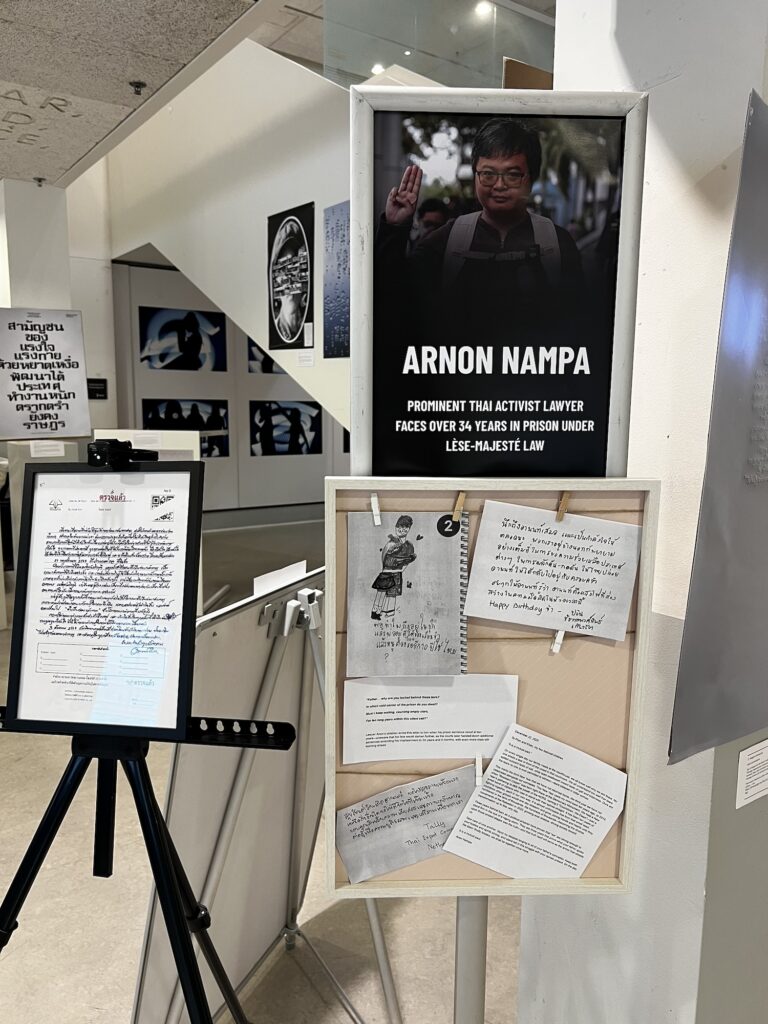
I shed quiet tears at points today as I read the words of someone I know—someone currently imprisoned—displayed in an exhibition thousands of miles from home. I did not expect to see them there, though I probably should have, given what the exhibition was about. It has been three years since we last spoke, yet there his words were, in black and white inside a London university, speaking to me once again. In that regard, the exhibition hit me hard, and I am incredibly grateful to Dr. Pavin Chachavalpongpun and his team for bringing it to the UK.
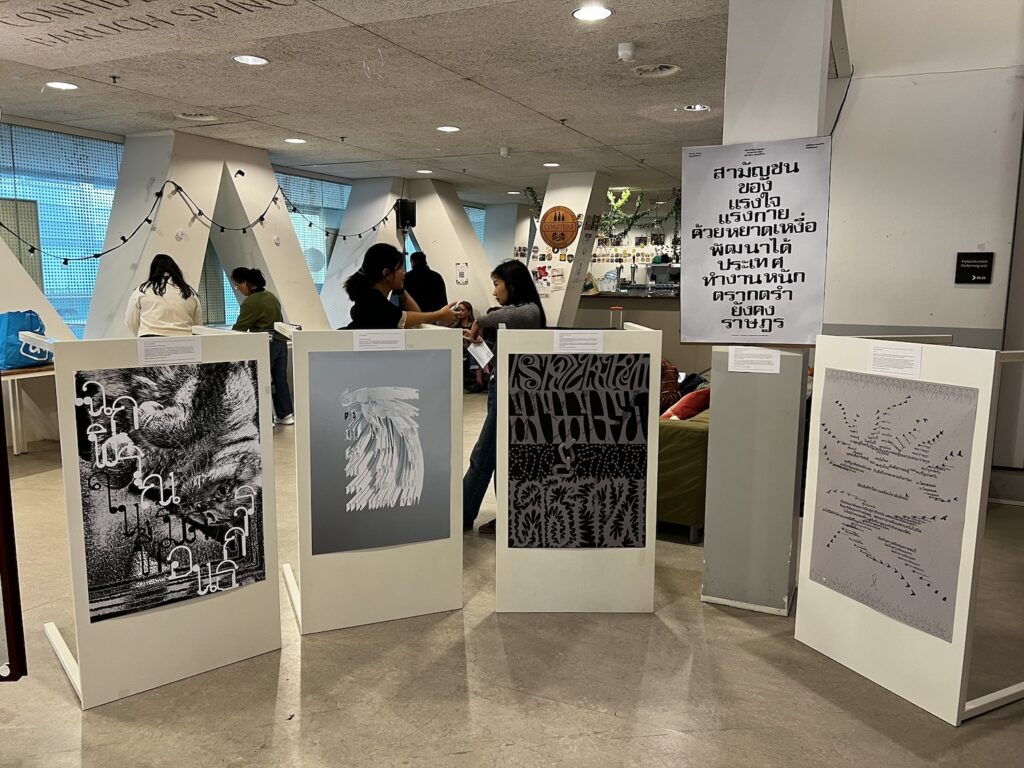
Though modest in scale, the 30 posters managed to convey an immense amount. Each piece offered a distinct perspective on the subject, both in its visual presentation and in the story it told. Moreover, a clear narrative emerged as you moved around the room, with each section opening up new layers of emotion and experience to consider. While the broader historical trajectory of Section 112 was not spelled out explicitly, the posters were arranged in a way that allowed the texture of that history to come through. For visitors without prior background knowledge of the crackdown in Thailand, the art and creativity helped bridge the gap; for those already familiar with what is happening, there were deeper layers in every piece to reflect upon. Each poster was accompanied by text—some naming the artist, others remaining anonymous, which I assume reflects the ongoing risk of reprisal where anonymity serves as a necessary shield.
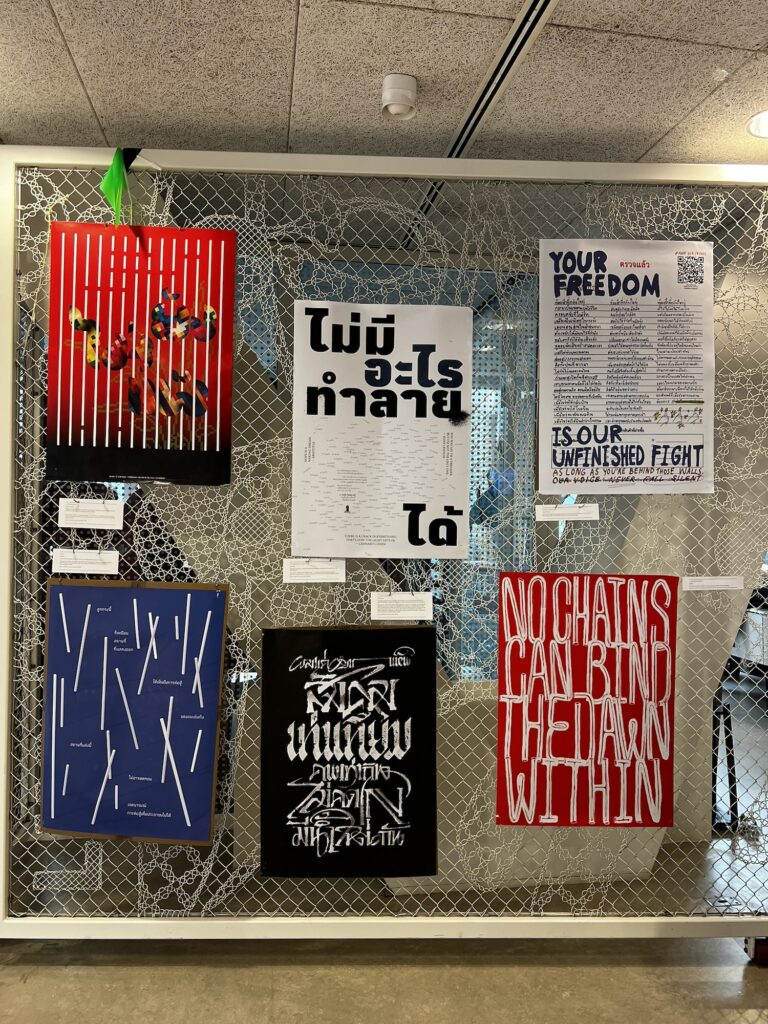
Some of the posters were colorful and eye-catching, bold and even defiant, looking as though they would not be out of place as a flyer or advertisement for a gig. The opening poster, "We are unbroken," carried accompanying text that read: "Whatever the chains they forge to oppress us, the roots of democracy and the righteous truth that this land belongs to the people will forever bloom." I actually returned to this piece as I was leaving. It felt fitting to hold onto that reminder: even if our Thai friends are not out on the streets right now, that sentiment endures. Indeed, at the time of writing, our friends in Indonesia are raising the three-finger salute and demanding better, much in the same way Thai youth did not so long ago.
Other posters—such as the one based on the letter from Anon Nampa to his children—were muted and subtle, with the words almost fading into the background, evoking the painful distance that comes with the loss of freedom. The exhibition did not shy away from confronting difficult realities: the severe mental health toll of incarceration, and the sense of loss and despair that accompanies every "guilty" verdict. There was no romanticization or glorification here. The exhibition stayed true to its title; the weight of sentences could genuinely be felt.
Despite the wide range of visual styles and messages, the pieces sat remarkably well alongside one another. Each led naturally into the next, almost as if the artists knew what would precede or follow their own work. I doubt they did, which speaks to the skill of the curation in achieving that cohesive effect. Once again, that cumulative weight made itself felt, with each piece building the breadth, depth, and heft of the overall message.
Three posters in particular will stay with me for a long time
The first was composed of calendar months spanning 18 years, beginning on the date of the prisoner’s incarceration and ending on their scheduled release date. Each day already served had been crossed off, with words running through those early months. Yet the vast majority of the calendar remained untouched, and as your eye scanned downward, the sheer enormity of the remaining time sank in. The accompanying poem by Wutthiphong, written from prison, hit especially hard after seeing such a stark visual representation. As someone also connected to the Hong Kong milieu, it reminded me of Joshua Wong—whose sentence, much like those of Thai activists such as Get Sophon Surariddhidhamrong and Anon Nampa, may start with a defined term only to be continually extended through charge-stacking designed to keep them detained longer and longer. It may have been a trick of the light or simply my own emotional reading, but the months printed toward the bottom of the poster seemed fainter, more uncertain.
The second poster took the visual form of a petition—echoing, I believe, the campaign demanding that Section 112 offenses be included in an amnesty bill—bearing the words: "Your Freedom is our Unfinished Fight. As long as you are behind bars, our voices will never fall silent." It stood as a promise to those behind bars that they will not be forgotten, a vow echoed across many struggles. The hashtag #FreeOurFriends also appeared on the poster, a tag frequently seen in campaigns for political prisoners not only in Thailand, but also in Cambodia, Indonesia, Myanmar, Hong Kong, and beyond.
The third piece read, "I just want it to end here." Two distinct interpretations immediately came to mind, leaving a deliberate ambiguity as to what the artist intended. One echoed the slogan of the recent youth movement—"May it end with our generation"—a cry of collective defiance. The other interpretation was far more literal and personal. I hope it is the former, and the accompanying text seemed to suggest as much, yet the artwork itself sits right on the knife-edge between defiance and despair, with the words rendered in bright red over the faint silhouette of a figure behind them.
While there are far more political prisoners and individuals affected by Section 112 than there were posters in the room, the breadth of voices represented was striking: young and old, men and women, trans, gay, and straight, urban and rural. Together, they demonstrated how the entirety of Thai society lives under this restriction. No one is beyond the reach of the lèse-majesté law—not a farmer in Khon Kaen, not a former Prime Minister (though Thaksin’s voice was not featured here), and everyone in between.
I recognized the names of perhaps a third of the individuals whose words were featured, while many others were unfamiliar to me—yet all of them share the injustice of having their freedom stripped away for advocating for greater freedoms in Thailand. A particularly thoughtful touch was that for almost all of the posters (all but six, if I counted correctly), a reference to a Thai Lawyers for Human Rights (TLHR) case file or prison visit note was provided, allowing visitors to learn more about each person and their case. Behind every single poster stands a real human being—either in jail, fighting a charge in court, living in exile, or waiting for a friend or loved one to come home.
Another aspect that made viewing the exhibition deeply meaningful was knowing that, in some form, several of these works will also be displayed in Bangkok from November 14 to 29. Knowing that gives me an experience I can share with my friends and allies back in Thailand, despite the physical distance separating us. On a day when a major Microsoft outage disrupted digital connections across the globe, it was a fitting reminder that with dedication and care, shared experiences can still bridge thousands of miles even without the internet. Exhibitions like this are a vital, tangible way for us to connect, listen to one another’s stories, learn from each other, and build solidarity across borders and contexts. Once again, my deepest appreciation goes to Pavin and his team for bringing this exhibition to the UK.
Xun-ling
#MilkTeaAlliance Calendar Team